It starts with a Sunday-morning pill organiser with all the daily doses: a blood-pressure tablet, a sugar tablet, a calcium capsule, and a quiet calculation in your head about the next clinic visit, the next blood test, the next refill.
When people search for health insurance for parents, nearly all of them are thinking about one thing: the hospital bill with too many zeros. Yes, fair enough. But talk to anyone who has looked after an ageing parent for a year, and you’ll hear a different story of bills that never stop. You see them more worried about the hefty expenses of monthly BP checks, quarterly sugar reports, eye tests, dental care, and, on top of that, the pharmacy run that somehow costs more each time.
All these OPD expenses add up year after year and quietly drain savings. Unfortunately most of it falls outside standard medical insurance. We’ll take a look at the bigger picture of health insurance for parents and see whether there is a scheme for senior citizens by the Government of India.
Why Your Parents' Healthcare Bills Only Move One Way
India is ageing fast. As per the UNFPA and IIPS India Ageing Report 2023, 149 million Indians were aged 60 or above in 2022, about 10.5% of the population. By 2050, that number is projected to reach 347 million, or 20.8%.
Health needs rise with age. According to the Longitudinal Ageing Study in India (LASI), run by IIPS for the Ministry of Health and Family Welfare, around 75% of people aged 60 and above live with at least one chronic condition. About 32% had been diagnosed with hypertension, and 14% reported diabetes. Chronic conditions mean repeat consultations, repeat tests and lifelong medicines.
Much of this comes out of your own pocket. The latest National Health Accounts (2022-23) put out-of-pocket spending at 43.4% of total health expenditure, up from 39.4% a year earlier. A peer-reviewed analysis of Indian household data, Components of Out-of-Pocket Expenditure and Their Relative Contribution to Economic Burden of Diseases in India, also found that medicines made up roughly 60% of outpatient out-of-pocket spending.
The Bigger Gap: Hospital Cover Does Not Pay for Everyday Care
Let’s start with an illustrative example of a year in a parent's health: a father in his late sixties with blood pressure and sugar to manage.
This is a made-up example, not a customer story, but you will probably recognise the rhythm.
- January: BP and sugar review, medicines refilled.
- April: Quarterly blood tests for sugar and cholesterol.
- June: A cough at 11 pm. Nobody wants to wait until morning.
- August: Eye check. The spectacle number has changed again.
- October: A tooth that has been "fine" for three weeks.
- December: The annual health check-up everyone promised to do.
Six moments, zero hospital admissions. Yet this is where the money quietly goes.
In India, a typical medical insurance policy for senior citizens is built around hospitalisation. If your mother is admitted for a fracture, the bill is covered, subject to policy terms. But regular plans generally leave the above shared expenses unless an OPD benefit is specifically included.
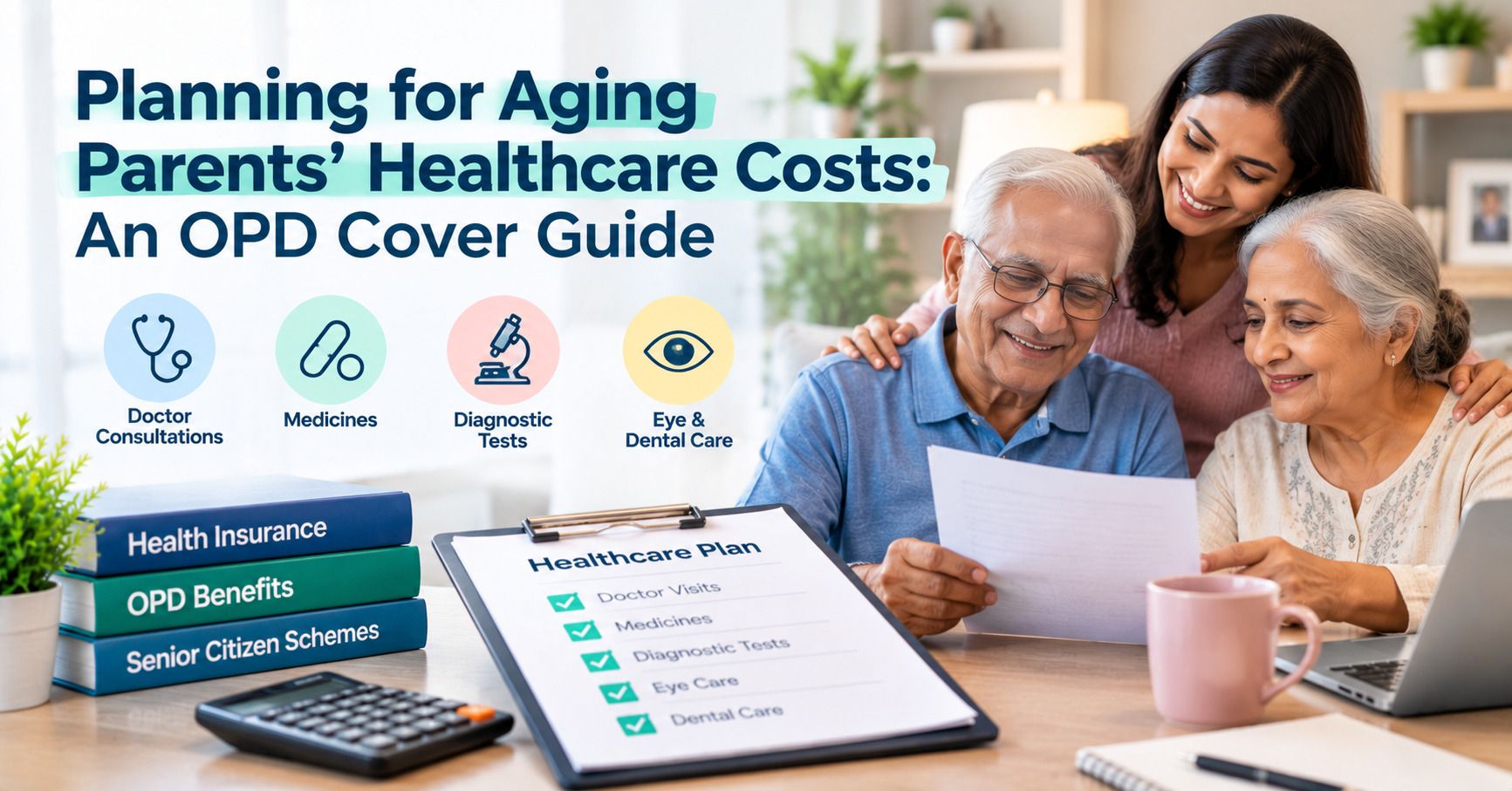
OPD simply means care that doesn’t require an overnight stay. Each item looks small. For a parent managing two or three conditions, they can add up to a serious annual expense. For a parent who is currently healthy, regular check-ups are what keep them that way.
Medical Insurance Policy for Senior Citizens: What the New IRDAI Rules Change
IRDAI has loosened the rules for senior citizens, making it easier to buy cover for older parents.
- No upper entry age. From 1 April 2024, the 65-year cap went away. Insurers must offer products for all age groups.
- Shorter waiting periods. The maximum wait for pre-existing diseases such as diabetes or hypertension is now three years, down from four.
- Five-year moratorium. After five years of continuous cover, an insurer cannot deny a claim over non-disclosure of a pre-existing illness, except in cases of fraud.
Tax angle: If you pay health insurance premiums for parents aged 60+, you can claim up to ₹50,000 a year under Section 126 of the Income-tax Act, 2025 (Section 80D as per the old tax regime).
While the above factors are better now, the catch is the same as before. These policies are designed for hospital bills. Day-to-day outpatient costs usually need a rider or a separate plan.
Senior Citizen Health Insurance Scheme by Government of India: What You Can Claim
Fortunately, Government of India offers support, and many families don’t realise it. If your parents are 70 or older, do this first. It is free.
- Ayushman Vay Vandana (under AB PM-JAY). Launched on 29 October 2024, it makes every citizen aged 70+ eligible for cashless hospital cover of up to ₹5 lakh a year, irrespective of income. More than 10 lakh seniors enrolled within about three weeks. Where the family is already covered under PM-JAY, the 70+ member gets a separate ₹5 lakh top-up. You can register through pmjay.gov.in or the Ayushman app using Aadhaar-based e-KYC.
- CGHS and ECHS. Central government pensioners and ex-servicemen have their own schemes. Seniors in these schemes generally have to choose one scheme or the other, so confirm the rule on the official portal.
- National Programme for Health Care of the Elderly (NPHCE). A Health Ministry programme that provides dedicated care for people aged 60+ through public health facilities.
Learn the limit: PM-JAY covers secondary and tertiary hospitalisation. It does not pay for monthly check-ups, diabetes test strips, or pharmacy bills. It is superb protection against the big shock and silent on the everyday.
So, What to Do? Build a Three-Layer Safety Net for Your Parents
Upfront, there is no best health insurance for parents. Think of your parents' healthcare plan as three layers, each doing a different job.
- Layer 1, government cover. Vay Vandana for parents aged 70+, or PM-JAY and CGHS where eligible. It is free or low-cost baseline protection for hospital stays.
- Layer 2, private hospital cover. A senior citizen policy or top-up sized to private hospital costs in your city, for the treatment the government scheme may not suit.
- Layer 3, everyday OPD cover. A dedicated plan for consultations, tests, medicines, eye and dental care, so routine care never gets postponed because of cost.
Layers one and two are the umbrella. Layer three is the raincoat you use every week. That third layer is where we come in.
7-Point Checklist
- Sum insured: enough for your city's private hospital costs.
- Co-payment: many senior plans make you share a percentage of each claim. Lower is better.
- Room-rent and sub-limits: caps can shrink the whole claim, not just the room charge.
- Pre-existing disease waiting period: ask for the exact number of years.
- Network and claim record: cashless hospitals near your parents, and the insurer's claim and grievance data published by IRDAI.
- Lifetime renewal and premium at older ages: ask what the premium looks like at 70 and 75.
- OPD benefits: inside the policy as a rider, or separately through a dedicated OPD plan.
Meet Prime Care: Everyday OPD Cover Built for Real Life
Prime Care is an OPD health plan operated by Zap Private Limited and powered by Alyve Health. It is not a hospitalisation policy. It does one job: making everyday care cashless and predictable through an annual OPD wallet that your parents use at Alyve Health network partners. See the full coverage breakdown here.
Why it suits parents: there is no OPD waiting period and no medical tests, so a parent with existing conditions is not turned away. Activation takes a 2-minute KYC. Every plan includes unlimited 24/7 GP tele-consultation, unlimited health assessments, a concierge desk, and one annual health check-up. We also offer a 15-day free-look refund if you don't use the benefits.
Pick a plan, activate your coverage with a 2-minute KYC, and start using cashless consultations, tests, and pharmacy benefits.
Frequently Asked Questions
Is there a government health insurance scheme for senior citizens?
Yes. Under Ayushman Vay Vandana (AB PM-JAY), every citizen aged 70+ is eligible for cashless hospitalisation cover of up to ₹5 lakh a year, irrespective of income. Register at pmjay.gov.in or through the Ayushman app.
Can I buy health insurance for parents above 65 or with pre-existing conditions?
Yes. IRDAI removed the maximum entry age from 1 April 2024. Pre-existing diseases can be covered after a waiting period of up to three years, so disclose all conditions honestly when you buy.
Is OPD insurance worth it for senior citizens?
It depends on how much your parents spend on everyday care. If consultations, tests, and medicines add up to near or above a plan's annual price, a cashless OPD plan can make costs predictable. If they rarely visit a doctor, it may not pay off.
What is the best health insurance for parents with a pre-existing condition?
Look for a hospital policy with a short waiting period for pre-existing diseases. IRDAI caps that wait at three years. Disclose everything honestly at purchase. For everyday visits and tests, an OPD plan such as Prime Care has no OPD waiting period.
What happens if my parents don't use the whole wallet?
Unused wallet balance does not carry forward to the next year. You can cancel within 15 days of purchase for a full refund if no benefits were used. After that, you can cancel annual plans for a pro-rata refund, minus benefits already used.