When did you last check your diabetes? Not the fasting reading on your glucometer last Tuesday, but the real number that shows how your sugar has behaved over the past three months?
Picture Rajesh. He is 46, works in accounts in Pune, and found out three years ago that he has type 2 diabetes. (Rajesh is made up, but we bet you know someone like him. Maybe you are him.) For the first few months, he was a model patient. But then work got busy, the clinic was far, and the blood test meant taking half a day off. His home readings looked okay, so why bother? Two years later, he has not had a proper diabetes check up since.
Here’s something to know: Work deadlines, family functions, festive sweets and the comforting thought of "I feel fine" push follow-ups to the bottom of the to-do list. Yet India has an estimated 101 million people living with diabetes and another 136 million with prediabetes, according to the ICMR-INDIAB study published in The Lancet Diabetes & Endocrinology. Most of them are in the same boat. They know they should follow up. They just are not sure how often, which tests to get, or who pays.
Diabetes follow up isn’t complicated. It needs one simple blood test, a few yearly screenings and a doctor you meet on schedule. We’ll help you understand what the HbA1c test is, why it is done, how to plan your year, and what OPD insurance may or may not do for your bill (because we know it is on your mind).
What Is the HbA1c Test?
HbA1c (also written A1C or glycated haemoglobin) is a blood test that shows your average blood glucose over roughly the past three months. Here is how it works: glucose in your blood attaches to haemoglobin, the protein in red blood cells that carries oxygen. The more glucose around, the more of it sticks, and the higher your percentage climbs.
Think of a finger-prick reading as a single photograph and HbA1c as the entire film. One sweet-heavy dinner will not fool it, and one good morning will not flatter it. The best part? You usually don’t need to fast, and the sample can be taken at any time of day.
Understanding your HbA1c result
| HbA1c result | Category | What it generally means |
|---|---|---|
| Below 5.7% | Normal | No diabetes detected |
| 5.7% to 6.4% | Prediabetes | Higher risk of diabetes; usually retested every year |
| 6.5% or higher | Diabetes | Confirmed with a second test on another day |
Doctors may also use a fasting glucose test or an oral glucose tolerance test to confirm. If you already live with diabetes, the usual HbA1c target is below 7%. But your personal goal may differ, so ask your doctor.
Why the HbA1c Test Matters
If you have ever wondered why an HbA1c test is done when you already check sugar at home, here is the answer:
- To diagnose diabetes and prediabetes. It is an established tool for spotting both, often before symptoms appear.
- To judge whether your treatment is working. Doctors use it to see how well you are managing diabetes and whether your plan or medicines need a change.
- To see the trend, not the blip. Meter readings capture moments; HbA1c captures the pattern.
- To lower your risk of complications. Higher HbA1c numbers mean higher blood sugar and a greater chance of diabetes-related problems.
Three myths we hear all the time
| What people say | What is actually true |
|---|---|
| "My fasting sugar was normal, so I am fine." | A fasting reading is a snapshot in time. HbA1c shows the three-month pattern, and doctors often look at both. |
| "I feel fine, so I can skip the check-up." | Diabetes can affect eyes, kidneys and feet quietly, which is why yearly screenings exist. |
| "One high HbA1c means I have failed." | It is a signal, not a verdict. Doctors use it to adjust your plan. |
Good to know: HbA1c does not show day-to-day swings or low-sugar episodes. Hence, doctors often pair it with home glucose readings or a continuous glucose monitor. Certain blood conditions, such as anaemia, can also affect the result, so mention any such condition to your doctor.
How Often Should You Get a Diabetes Blood Test?
The ADA Standards of Care in Diabetes 2026 advise assessing glycaemic status at least twice a year, and more often (for example, every three months) if you are not meeting goals, have had a recent treatment change, or have frequent highs or lows. Even the CDC offers the same practical rule:
- Meeting your goals and treatment is stable: HbA1c every 6 months.
- Treatment changed or goals not met: HbA1c every 3 months.
- Prediabetes: usually once a year.
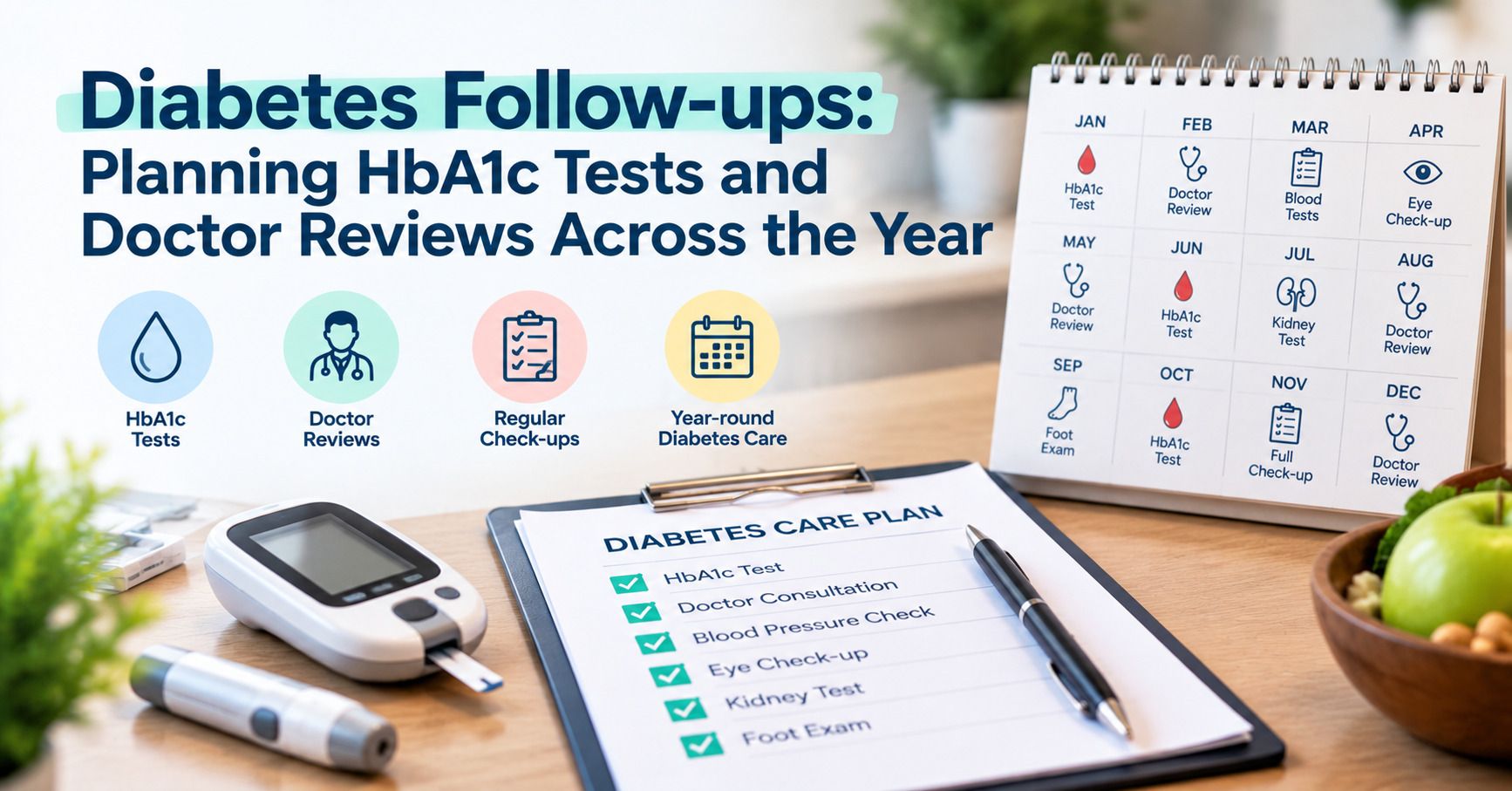
Your 12-Month Diabetes Check-Up Calendar
Planning beats remembering. Find the column that matches you, save the months in your phone and stick to them.
| Quarter | Stable and at goal (twice-a-year track) | Adjusting or above target (every-3-months track) |
|---|---|---|
| Jan to Mar (Annual deep-dive) | HbA1c plus your yearly diabetes health check (kidneys, cholesterol, eyes, feet). Set goals for the year. | HbA1c #1, full annual screening and doctor review |
| Apr to Jun (Mid-course check) | HbA1c, review of home readings, weight and blood pressure, medicine check. | HbA1c #2, doctor review, medicine and diet adjustments |
| Jul to Sep (Second check) | HbA1c and a proper chat with your doctor about what is working. | HbA1c #3 and doctor review |
| Oct to Dec (Festive finish) | HbA1c if on the 3-monthly track, weight and blood pressure. Ask about vaccines and how to handle festivals, travel or fasting. Book next year. | HbA1c #4, doctor review, plan next year's targets |
If medicines changed recently, or numbers are above target, take all four HbA1c tests. If stable and on target, visits 1 and 3 are your must-dos. This is a starting framework, not a prescription. If your doctor suggests a different rhythm, follow it.
Also read Planning for Aging Parents' Healthcare Costs: An OPD Cover Guide.
Beyond HbA1c: The Complete Diabetes Health Check
HbA1c tells you about sugar. But diabetes can quietly affect other organs too, so a proper diabetes health check looks at more than just blood sugar. According to the CDC care schedule and MedlinePlus, these are the yearly essentials:
- Kidney tests: a urine albumin test, with blood creatinine as your doctor advises.
- Cholesterol test: a lipid profile for cholesterol and triglycerides.
- Dilated eye exam: catches diabetes-related eye changes early. More often if you already have eye problems.
- Complete foot exam: more often if you have had foot problems. At home, check your feet daily for cuts, blisters, or redness.
- Dental exam: tell your dentist that you have diabetes.
Get to know if your health insurance covers dental treatment.
Make Every Doctor Review Count
A review is only as useful as the preparation behind it. Carry these along:
- Your glucose log or continuous glucose monitor report and the list of every medicine and supplement you take
- Your latest blood reports and screening results
Then ask your doctor:
- Is my HbA1c target right for me?
- What do my results say about the last three months?
- Do my medicines or doses need a change?
- How do I handle weddings, travel and festival fasting safely?
- When should I come back?
Five Habits That Keep Your Plan on Track
- Set three reminders: a week before, a day before and on the day of your test.
- Stay with one lab when possible: it makes your trends easier to compare.
- Keep a health folder: one place, paper or digital, for every report.
- Move daily: the CDC suggests about 30 minutes of moderate activity every day.
- Take medicines as prescribed, even when you feel fine.
Let Us Talk Money: Diabetes Check Ups and OPD Insurance
Honestly, cost is one of the biggest reasons follow-ups get postponed. The government's National Health Accounts estimate that out-of-pocket payments made up 43.4% of India's total health spending in 2022-23, which shows a big chunk paid straight from our own wallets.
And here is the catch many people discover too late. Standard health insurance in India is built around hospitalisation, usually a stay of 24 hours or more, with a list of day-care procedures as the exception. Unfortunately, a diabetes blood test or a doctor consultation without admission often falls outside it, unless your plan has an OPD benefit, a health check-up benefit or an OPD add-on. Many insurers offer OPD cover as an optional add-on, but what it pays varies widely.
How We Help at Prime Care
We hear the same couple of common excuses: "I forgot" and "I could not find the time". While all of it is true, one more reason that it all often comes down to is OPD expenses and an unplanned budget, especially in Indian families. People avoid regular diagnoses and check up because of financial constraints.
So we try to take the hassle out of the follow-up. With Prime Care OPD specific plans, you get a handsome annual wallet to cover most of your non-hospitalisation expenses, that too cashless. Our coverage also includes Teleconsultation services and Habit coaching that can help during long-term care.
So, What Happened to Rajesh?
He booked his test last month and the result came back a little above target. Not a disaster, just a signal. His doctor tweaked the plan, he started walking after dinner and the next test is already in his calendar.
That is all a good diabetes check up really is: a signal, and a plan. Ready to get yours? Book your HbA1c test, add a full diabetes health check or speak to a doctor today with Prime Care.
Frequently Asked Questions
What is an HbA1c test, and do I need to fast for it?
The HbA1c test is a blood test that shows your average blood glucose over about the past three months. It measures how much glucose is attached to haemoglobin in your red blood cells. Fasting is usually not required, and you can give the sample at any time of day.
Why is the HbA1c test done when I already check my sugar at home?
Home readings show one moment; HbA1c shows the overall pattern. Doctors use it to diagnose diabetes and prediabetes, to see whether your treatment is working and to estimate your risk of complications.
How often should I get a diabetes test?
At least twice a year if your sugar is stable and on target, and every three months if your treatment has changed or you are not meeting your goals.
What is a good HbA1c level for someone with diabetes?
For many adults with diabetes, the usual target is below 7%. However, goals are individualised. Older adults or people with other serious illnesses may be given a different target, so always confirm yours with your doctor.
What does a complete diabetes health check include?
Along with HbA1c, a yearly check typically covers kidney tests, a cholesterol profile, a dilated eye exam, a complete foot exam and a dental check, with weight and blood pressure reviewed at your visits.
Does health insurance cover diabetes check ups and the HbA1c test?
It depends on your policy. Standard plans focus on hospitalisation, so routine consultations and tests usually require an OPD benefit, an OPD add-on, or a health check-up benefit.