
Ear, Nose and Throat Issues: When a GP Is Enough and When You Need an ENT

13 NOV '2611 min
It often starts innocently with something like a heavy cold, a blocked nose, and then a throbbing pain deep inside your ear that wakes you at 2 a.m. Or perhaps your nose has been “blocked since the monsoon”, your ear itches after every swim, or a sinus headache laughs at every tablet you try. Meanwhile, WhatsApp advice from relatives ranges from “pour in warm oil” to “just ignore it”.
India’s Ministry of Health, citing WHO estimates, still quotes an older figure of around 63 million people, or 6.3% of the population, living with significant hearing impairment. The exact count may have changed, but the message has not: your ears, nose and throat deserve better than guesswork and home remedies.
But the bigger question is, who should you see first: your neighbourhood general physician (GP) or an ENT specialist? We will answer that clearly and explain ear pain due to cold, fungal ear infection symptoms, nasal polyps types, throat warning signs, and even what a PNS X-ray costs, so you can decide quickly, without wasting time or money.
The 60-Second Answer: GP or ENT?
In 2024, India’s National Programme for Prevention and Control of Deafness was running in 587 districts across 36 states and Union Territories. Ear care is a national health priority, not a minor issue. So, it’s important to understand how to choose your doctor.
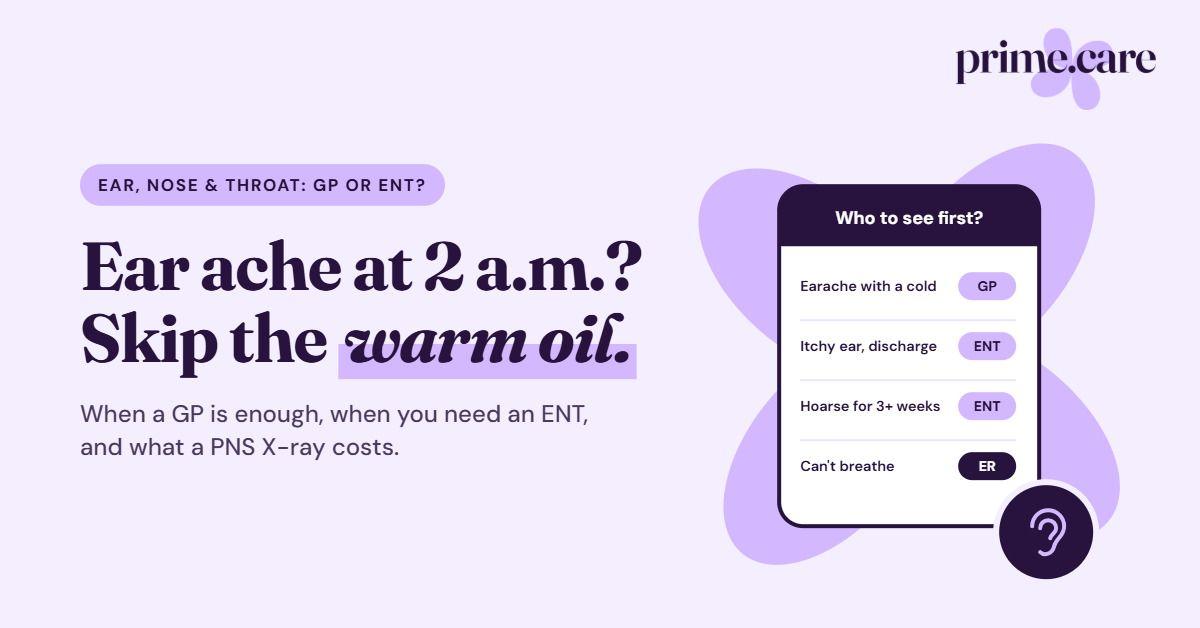
Start with a GP for mild, short-lived, first-time problems. Go to an ENT specialist when symptoms are one-sided, lingering, recurring or getting worse. Here is your quick cheat sheet.
| Your symptom | Start with | Why |
|---|---|---|
| Mild earache with a cold, improving daily | GP | Usually settles as the cold clears |
| Earache beyond 3 days, or earaches that keep returning | GP, then ENT | Needs a proper ear examination |
| Itchy, blocked ear with discharge, mostly in one ear | ENT | Debris often needs careful cleaning |
| One-sided blocked nose or fading sense of smell | ENT | Needs a look inside with an endoscope |
| Sinus symptoms lasting 12 weeks or more | ENT | May need endoscopy or imaging |
| Sore throat or fever lasting 1-3 days | GP | Most settle within a week; a GP can rule out an infection that needs treatment |
| Hoarse voice for 3+ weeks, or a lump in the neck | ENT promptly | Needs a throat examination to rule out serious causes |
| Trouble breathing or swallowing, or drooling | Emergency care now | Do not wait for an appointment |
| Sudden hearing loss, or swelling behind the ear, or pus or bleeding from the ear | ENT or emergency care today | Time-sensitive problems |
Three quick (illustrative) examples: Rohan, 28, has a cold and mild earache on day two, so a GP, a flannel and rest are enough. Meera, 41, has an itchy, discharging left ear after a monsoon swim, which calls for an ENT. Imran, 35, has had a blocked right nostril and fading smell for two months, which means an ENT and an endoscopy.
Ear Pain Due to Cold: Why Your Ear Hurts When Your Nose Is Blocked
Blame the Eustachian tube, a thin passage that links your middle ear to the back of your throat. Its job is to balance pressure. When you catch a cold, the tube swells and clogs, so fluid and mucus get trapped behind the eardrum, and that is when the earache begins. This is the reason why colds so often end with a full, muffled, painful ear.
What You Can Do At Home
The NHS suggests a warm or cold flannel on the ear, and not putting anything inside it, not even cotton buds. In India, that rule also covers hairpins, car keys, matchsticks and homemade oil drops, which can harm an already irritated ear. Your eardrum is thinner than you think. Parents must also note that most earaches in children come from an ear infection and usually begin to improve after a few days.
Children need a doctor sooner. Do not wait if a child has a high fever, pus or fluid coming from the ear, unusual drowsiness or irritability, or a severe headache with a stiff neck. A baby under six months with earache should also be seen by a doctor, as should a child under two with earache in both ears.
When a GP Is Enough, and When It Is Not
See a GP if the pain lasts more than three days or keeps coming back. Ear pain with muffled hearing may point to glue ear, earwax or a perforated eardrum. Pus from the ear, or swelling and redness behind it, needs prompt medical attention. If hearing stays dull for weeks after the cold has gone, ask for an ENT referral.
Fungal Ear Infection Symptoms: The Monsoon Menace
Humid months bring a sneaky visitor. Otomycosis, the medical name for a fungal ear infection, thrives in hot, humid weather, which makes India’s rainy months a prime season. Roughly 90% of cases are caused by Aspergillus moulds, and most of the rest by Candida. Typical fungal ear infection symptoms include:
- Intense itching, the most frequent complaint; 84.95% of patients in one Indian study reported it.
- Blocked or full feeling in the ear, sometimes with reduced hearing.
- Pain and discharge, which may look creamy or blackish.
- Ringing in the ear (tinnitus).
Usually only one ear is affected. Heat, humidity, previous ear surgery, bacterial infection and weak immunity raise the risk.
GP or ENT?
Fungal and bacterial ear infections can look alike, yet they are treated differently, and the wrong drops can delay recovery. An ENT can examine the canal under magnification, gently remove fungal debris and prescribe the right antifungal. If you are diabetic, have had ear surgery, or suspect a hole in the eardrum, go to an ENT first. And please do not reuse leftover ear drops from an old prescription without asking a doctor.
Simple Prevention Tips
Prevention is boringly simple: dry your ears gently after a bath or swim, avoid poking them with cotton buds, and do not share earphones. Keeping water out of the ear when it is already sore is also NHS advice. These small habits matter most during humid months.
Nasal Polyps Types: Ethmoidal vs Antrochoanal
Nasal polyps are soft, non-cancerous swellings of the lining of the nose and sinuses. ENT teaching material from GMCH-32, Chandigarh, classifies them into two main types.
| Feature | Ethmoidal polyps | Antrochoanal polyps |
|---|---|---|
| Where they start | Ethmoid air cells, between the eyes | Maxillary sinus, in the cheek |
| Usual pattern | Often multiple, on both sides | Usually single and one-sided |
| Early clues | Sneezing, watery discharge, stuffiness | One-sided blockage and discharge |
Ethmoidal polyps are linked with allergy, and asthma commonly coexists. Antrochoanal polyps are typically managed by surgical removal.
Why You Need An ENT For Polyps
Because polyps hide deep inside the nose, where a GP’s torch cannot reach. An ENT uses a nasal endoscope, a thin camera, to confirm the type and plan treatment, whether medicines or surgery. Early diagnosis also helps your doctor spot linked problems such as asthma. A blocked nostril on just one side, a fading sense of smell or snoring that has suddenly worsened should never be dismissed as “just an allergy”.
Throat Troubles: Sore Throat, Tonsillitis and Hoarseness
Most sore throats come from a cold or flu and settle by themselves within about a week, so a GP is the right first stop. See a GP if it has not eased after a week, or if you keep getting sore throats. Tonsillitis that does not clear within a week or keeps coming back also needs a GP visit, and your GP can discuss an ENT referral if infections keep returning.
See an ENT promptly if:
- Your voice stays hoarse for three weeks or longer. Persistent hoarseness can be an early sign of laryngeal (voice box) cancer, so it should never be brushed off as a “tired throat”.
- You find a lump or swelling in the neck, or have lasting pain or difficulty swallowing.
Tobacco users, please do not wait. India’s GATS-2 survey found that 21.4% of adults use smokeless tobacco such as gutka or khaini, and 28.6% use tobacco in some form. Tobacco raises the risk of cancers of the mouth and throat, so a voice change, a mouth ulcer that does not heal or a neck lump deserves an ENT’s attention at once.
Go to emergency care straight away if you cannot swallow, have trouble breathing or are drooling.
PNS X-Ray Cost: What You Pay and What You Get
PNS stands for paranasal sinuses, the air pockets around your nose. A PNS X-ray is a quick, low-cost way to look for signs of sinus trouble, such as fluid or a thickened lining.
However, its limits matter. In a 2024 study of 100 patients, X-ray PNS showed 67% sensitivity and 60% specificity, with 66% overall accuracy compared with CT. In simple words, an X-ray is a useful first screen, but a normal film does not always mean healthy sinuses.
PNS X-ray cost varies by city, centre and report time, so there is no single national price. As a benchmark, the CGHS rate list effective 13 October 2025 (which replaced the June 2023 revision) sets a PNS X-ray of one film at ₹200 at a NABH-accredited centre in a Tier I city and ₹170 at a non-NABH one, with lower rates in smaller cities. These are government reference rates, not what every private lab charges, so expect some variation. For context, the same list prices a CT scan of the paranasal sinuses (without contrast) at ₹2,300 at a NABH-accredited Tier I centre.
Three Ways To Avoid Overpaying
- Ask your doctor whether you need an X-ray, endoscopy or CT, so tests are not repeated.
- Carry old reports and films to every consultation.
- Choose accredited centres that show clear price lists.
Red Flags: Do Not Wait for an Appointment
Seek urgent medical care the same day if you notice:
- Sudden hearing loss in one or both ears
- Swelling or redness behind the ear, or pus draining from it
- Swelling around the eyes, vision changes or severe headache with sinus symptoms
- Blood-stained discharge from one nostril that keeps recurring
- Trouble breathing or swallowing, or drooling
How prime.care Makes the Right Call Easier
Not every sniffle needs a specialist, and not every earache can wait. Listening to your body early is the cheapest treatment there is. Choosing between a GP and an ENT should not be stressful, and that’s our job.
With prime.care OPD plan, you can book an ENT consultation for ear, nose and throat concerns, start with a general physician for mild symptoms, and arrange diagnostics such as a PNS X-ray when your doctor advises it. Everything is cashless and paid directly from your wallet across our partner network. Moreover, you get benefits like tele-consultations (both GP and specialties) and wellness sessions.
Do not guess, get checked. Speak to the right doctor, at the right time. Get your coverage, instantly, no waiting-period.
Frequently Asked Questions
Can a cold really cause ear pain in adults?
Yes, a cold can block the Eustachian tube, leading to fluid build-up and pain. It usually eases as the cold settles. See a GP if the earache lasts more than three days, keeps returning, or comes with pus or swelling behind the ear.
How do I know if I have a fungal ear infection?
Persistent itching, a blocked feeling and discharge in one ear are typical fungal ear infection symptoms. Only an examination can confirm it, so see an ENT rather than trying leftover drops.
Do all nasal polyps need surgery?
No. Treatment depends on the type, size and symptoms, and your ENT may begin with medicines. Antrochoanal polyps are generally removed surgically. An endoscopic examination decides the plan.
What is the average PNS X-ray cost in India?
Prices differ by city and centre. As a benchmark, the CGHS rate list effective 13 October 2025 sets a PNS X-ray of one film at ₹200 at a NABH-accredited centre in a Tier I city and ₹170 at a non-NABH one, with lower rates in smaller cities. Compare accredited centres and ask whether the report is included.
Can my GP treat sinusitis, or do I need an ENT?
Initially, a GP can manage for a short period. Visit an ENT if symptoms last 12 weeks or more, keep returning, or involve one-sided blockage, because these may need endoscopy or imaging.



 Message us on WhatsApp