
Recurring Acidity and Stomach Trouble: When to See a Gastroenterologist

10 NOV '2611 min
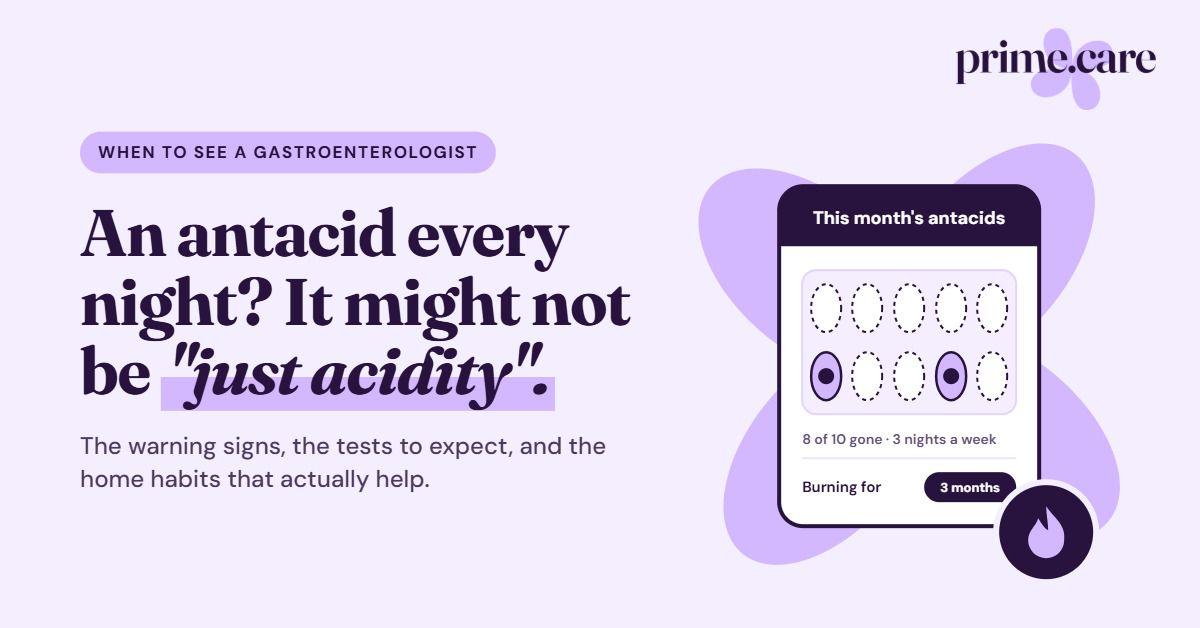
It always starts small, like the burning feeling after a heavy dinner and a sour taste at the back of your throat when you’re sitting up in bed with one hand on your chest and the other thumb scrolling. You blame the extra spicy chaat, pop an antacid, it works and you sleep. Tomorrow, you forget. Then it returns on Tuesday, again on Thursday, and soon that little acidity becomes a regular thing. Three nights a week, three months running, and now you’ve had one heart attack scare, tried a jeera-water cure, and read a cousin's WhatsApp forward about cold milk. None of it agrees.
Most of us know this scene. Acidity is the most ordinary complaint going, and that is exactly why people carry it around for months. Festive sweets, wedding buffets, a skipped lunch, one more chai. The antacid strip lives in the bag, and nobody books a doctor for "just acidity".
But there is a difference between occasional acidity and a stomach that is trying to tell you something. We will tell you how to spot that difference, which warning signs matter, which tests may be needed, and when exactly it is time to see a gastroenterologist.
Acidity vs. Gastritis: What Is Actually Going On?
Acidity is a loose, everyday word for that burning discomfort in the chest or upper abdomen. Doctors look at what sits behind it. Sometimes it is acid reflux, sometimes it is gastritis:
Acid reflux happens when stomach acid flows back into the food pipe. According to the NHS, the main signs are heartburn (a burning feeling in the middle of the chest) and a sour taste in the mouth, usually worse after eating, lying down or bending over.
Gastritis is different. It is inflammation of the stomach lining itself. According to Mayo Clinic, the most common cause is infection with the bacterium Helicobacter pylori. Regular use of painkillers such as ibuprofen or naproxen, heavy alcohol consumption, severe physical stress and autoimmune conditions can trigger it.
It may cause a burning or gnawing pain in the upper abdomen that gets better or worse after eating, along with nausea, vomiting and a feeling of fullness soon after starting a meal. But the sneaky part is, gastritis does not always cause symptoms, and when it does, it can look a lot like ordinary indigestion.
In India, H. pylori is far from rare. As per a study published in the Indian Journal of Medical Research, it was found in 27 per cent of patients in a Sikkim hospital sample, and the authors cited much higher rates among Indian patients with ulcers and non-ulcer dyspepsia at other centres. Untreated gastritis may lead to stomach ulcers and stomach bleeding.
According to the NHS, a stomach ulcer, a hiatus hernia or a bacterial infection in the stomach can sit behind heartburn too. You cannot tell them apart by how the burn feels. That is the whole reason doctors exist. Finding the cause early is almost always easier, and kinder to your wallet, than treating a complication.
Antacid Trap
Antacids are not the villain; they neutralise acid and give quick relief. But they are meant for short-term use, not as a daily habit. Relief feels like a solution; the pain goes, so the problem seems to go. However, if the real cause is an infection or irritation of the lining, it carries on quietly.
Signs It Is Time To See A Gastroenterologist
Think of your stomach as a polite guest who has been dropping hints. Here is when the hints turn into a request:
- Symptoms last a week or longer.
- Acidity keeps returning despite smaller meals, fewer spicy dishes and over-the-counter antacids.
- You are relying on antacids daily. If tablets have become a routine, the cause is untreated.
- You feel full after a few bites, or you are losing weight without trying.
- Nausea or vomiting is frequent, or you cannot keep food down.
- You take painkillers often for joint pain, back pain or headaches. NSAIDs can irritate the stomach lining, so your doctor needs to know.
- You have a family history of stomach problems, ulcers or stomach cancer.
And now the non-negotiables which Mayo Clinic says to get immediate care for: severe stomach pain, vomiting blood, blood in the stool or black stools, and for vomiting that stops you keeping food down. These are signs of possible bleeding and cannot wait for a convenient weekday.
Doctors also treat a few other signs as alarm signs, because they need a prompt check rather than a wait-and-see: difficulty or pain while swallowing, food sticking in your throat, unexplained weight loss, vomiting that keeps coming back, and signs of anaemia such as unusual tiredness, breathlessness or pale skin. Age matters too. If you are over 55 and your symptoms keep coming back despite treatment, an upper GI endoscopy can be considered. You can read the full list of alarm features in this review in the British Journal of General Practice.
Not sure whether your symptoms need a specialist? Start with a tele-consultation on Prime.care. A doctor can assess you first and refer you to a gastroenterologist if needed, with no guesswork and no running from clinic to clinic.
Why You Might See A Gastritis Specialist Instead Of Your Family Doctor
Your general physician is a great first stop for a mild stomach upset. But when symptoms are recurring, a gastritis specialist, formally a gastroenterologist, brings deeper training in the digestive tract. Either way, expect a conversation first, not a pile of tests. Your doctor will ask when the burn happens, what you eat, which medicines you take, and whether anything else has changed, such as your weight or your stool. Based on that, they decide what, if anything, to test.
Tests Your Doctor May Suggest, And What They Cost
Once a doctor has examined you and heard your history, a few simple tests usually come first. Here is what they do in plain language.
Whole Abdomen Ultrasound
In abdominal ultrasound, sound waves are used to look at the liver, gallbladder, pancreas, kidneys, spleen and surrounding structures. It is painless, takes about 15 to 30 minutes and involves no radiation, which means it is generally safe. Doctors often order it to rule out gallstones, fatty liver or other causes of upper abdominal pain that can feel just like acidity.
Stool Test
As described by NI Direct, the UK government's health information service, a stool test can check for infection or for hidden bleeding from the stomach. For suspected H. pylori, a stool antigen test is a common, non-invasive option. It can also confirm that the infection has cleared after treatment.
Endoscopy with Biopsy
If symptoms are persistent or worrying, your gastroenterologist may recommend an endoscopy, where a thin camera is passed through the throat to look at the stomach lining directly. Doctor may also suggest Biopsy, where they take a small tissue sample for test. It is the most accurate method for H. pylori.
Breath Tests
Conducting a breath test for H. pylori is another option. Antibiotics, bismuth medicines and acid-reducing PPIs may need to be stopped up to two weeks beforehand. Your doctor will explain which fits your situation and never stop a prescribed tablet on your own.
Headache Due To Acidity: Is It Real?
Many people say their headache arrives hand in hand with acidity, especially after skipped meals, late dinners or a night of poor sleep. It is worth being clear here: acidity itself is not an established direct cause of headaches. What often happens is that the same triggers, such as skipping meals, dehydration, stress and irregular sleep, can lead to both.
There is one more link worth checking. If you pop a painkiller every time your head aches, you may be inflaming your stomach lining further, since regular NSAID use is a recognised cause of gastritis.
If both headaches and acidity are frequent, let a doctor look at the whole pattern rather than treating each one separately.
Home Remedy For Hyperacidity Worth Trying
For mild, occasional symptoms, a few sensible habits that come straight from the NHS and NI Direct can help:
- Eat smaller meals more often instead of two or three heavy ones and try to relax while eating.
- Do not lie down straight after dinner. Leave 3 to 4 hours between your last meal and bedtime.
- Limit irritants such as coffee, chocolate, fatty, very spicy, acidic or fried foods.
- Cut back on alcohol, which irritates the stomach lining.
- Manage stress with a short walk, breathing exercises or better sleep to calm a sensitive stomach.
- Raise the head of your bed by 10 to 20 cm using blocks or books. Don’t use extra pillows, as they make symptoms worse.
- Lose weight if you are overweight. Carrying extra weight is a known trigger for reflux, and the NHS lists weight loss as a standard tip.
- Stop smoking. The NHS lists this alongside cutting back on alcohol as a simple way to ease acid reflux.
- Ask a pharmacist about over-the-counter antacids, which can neutralise acid and relieve pain quickly, but only for short-term use.
If a home remedy for hyperacidity works within a few days and the symptoms stay away, great. If they keep coming back, the remedy is only hiding the problem, not solving it. It is time for a proper check.
How To Prepare For Your Gastroenterologist Visit
- Note when symptoms occur: after meals, at night, or on an empty stomach.
- List every medicine you take, including painkillers and supplements.
- Mention any weight change, vomiting, or changes in stool colour.
- Carry old reports, prescriptions and scans.
- Write down your questions so nothing is forgotten in a short appointment.
Do Not Let "Just Acidity" Become A Bigger Problem: How prime.care Helps
Your stomach rarely complains without a reason and an early answer brings relief and peace of mind. Most people stress it more when it comes to healthcare expenses. Let’s talk about it, because that alone quietly decides who gets checked and who waits.
You may want to know the price of a whole abdomen ultrasound or stool test. In reality, the abdominal ultrasound cost differs widely across India, depending on the city, the type of centre (hospital, standalone lab or diagnostic chain), the equipment and whether it covers the whole abdomen or only the upper abdomen. The stool test price is usually among the more affordable investigations, but it too varies by lab and by which tests are bundled together.
To give you a benchmark, here are the rates fixed by the Central Government Health Scheme (CGHS) for empanelled hospitals in Delhi and NCR, as per its package rate list updated on October 2025 (shown as non-NABH/NABH-accredited): an OPD consultation is ₹350, a gastroscopy (upper GI endoscopy) is ₹2,720/₹3,200, and a urea breath test for H. pylori is ₹1965/₹2312. These are government reference rates, so private prices in your city can be higher or lower. Still, they give you a sensible yardstick to compare any quote against.
Each one of these do not look expensive one by one. Together they add up, and in India most of it comes straight out of pocket.
This is where OPD cover earns its keep, built for exactly these everyday costs. At Prime.care, the idea is that you should never delay a check-up because of a small bill.
Ready to take the first step? Check our OPD-specific plans, see what we cover, and get your plan activated with ease. We will take care of your bills.
Do not let "just acidity" run your day. Get it checked, get answers, and get back to enjoying your food.
Frequently Asked Questions
1. Who is a gastritis specialist?
A gastritis specialist is a gastroenterologist, a doctor who diagnoses and treats digestive conditions, including inflammation of the stomach lining. Consider booking if acidity or upper stomach pain lasts a week or more, or keeps returning.
2. Is the whole abdomen ultrasound price the same everywhere?
No. The whole abdomen ultrasound price depends on your city, the type of centre and what the quote includes. Ask whether the radiologist's report is part of the price, and compare a couple of accredited centres.
3. What does a stool test show?
For stomach problems, a stool test can detect H. pylori, a common cause of gastritis, and can later confirm whether the infection has cleared, according to MedlinePlus. The stool test price depends on the lab and on whether it is bundled with other tests.
4. Can acidity cause a headache?
The two often appear together, but that does not prove one causes the other. Skipped meals, stress and poor sleep can trigger both. Regular anti-inflammatory painkillers can also irritate the stomach, so see a doctor if both keep recurring.
5. Which home remedy for hyperacidity works best?
Smaller meals, a gap of three to four hours before bed, fewer personal triggers, less alcohol and a raised head of the bed help many people. If symptoms continue beyond a week, see a doctor.


 Message us on WhatsApp