Okay, we all would agree that hospital visits are already stressful enough. When you have someone who needs medical help, and you’re right at the reception counter struggling with stack after stack of paperwork, the last thing you’d want is to translate hospital shorthand just to get care. Yet the staff at the desk asks, “Are we registering this as an OPD consultation, or is it an IPD admission?” and what you choose dictates the process for you.
Long story short, it is important that you know the difference between IPD and OPD since these are the terms medical staff and insurers throw around all the time. It decides whether you head home with a doctor's prescription in an hour or get assigned a hospital bed, how high your final bill will be, and whether your health insurance will pay for the treatment or reject your claim.
We are here to help you understand everything end to end, so you confidently know what your family needs.
Difference between IPD and OPD: Full Form, Characteristics, Examples
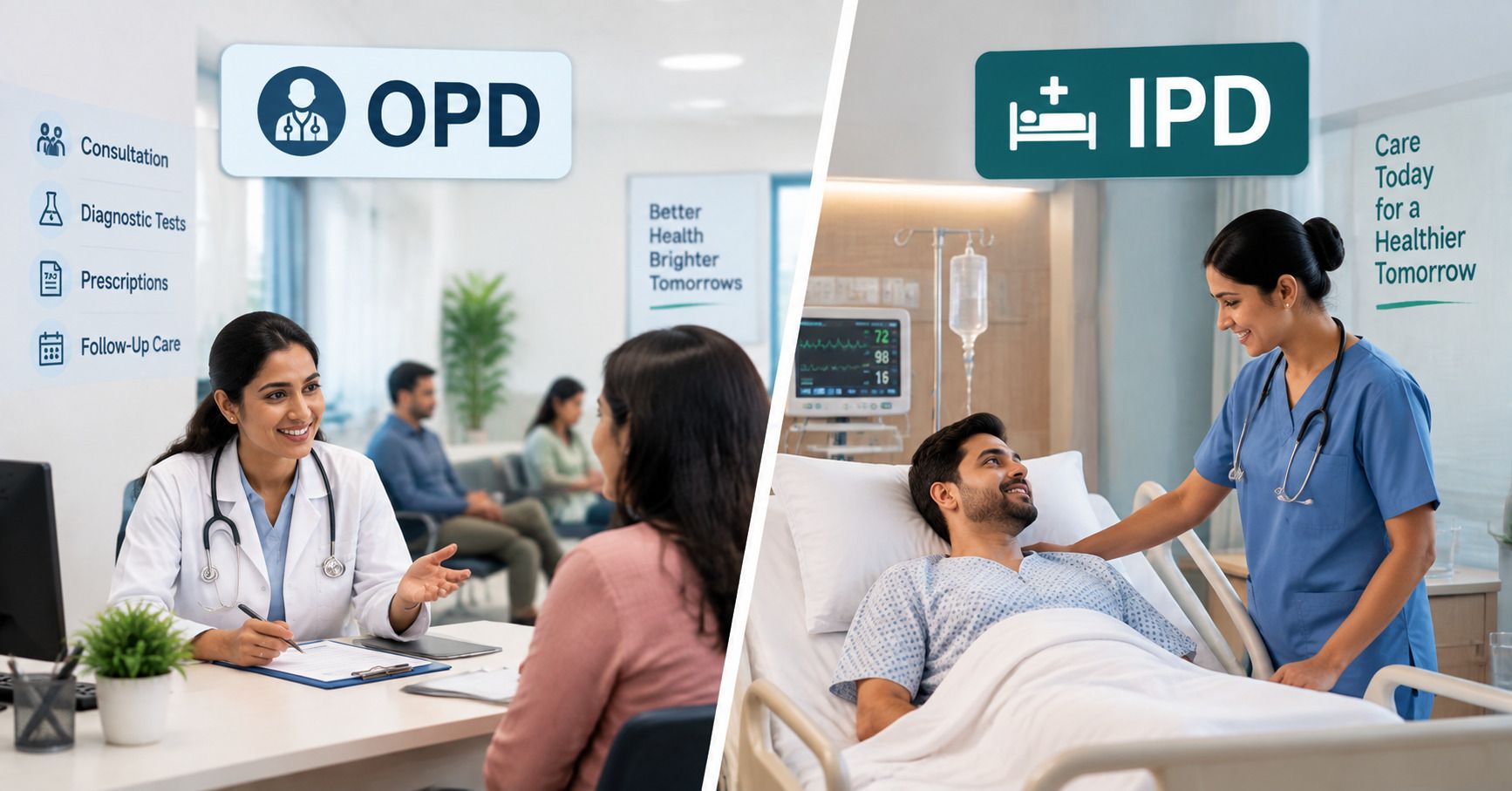
Simply put, one gets you treated and sent home the same day, while the other involves an overnight hospital stay, bed charges, and round-the-clock nursing care.
What Is OPD Treatment?
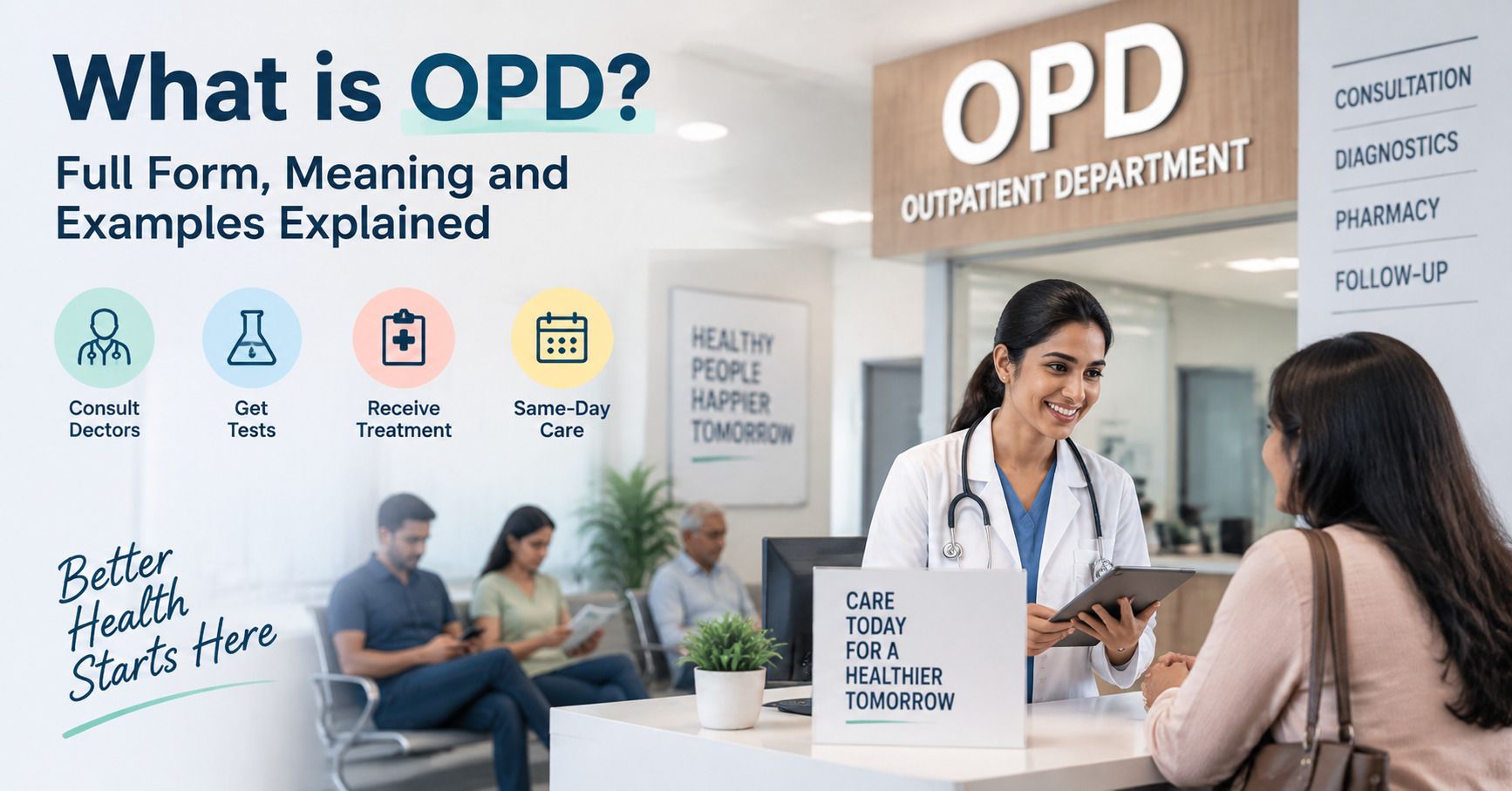
OPD full form is Outpatient Department. It refers to the department of a hospital or clinic where you consult a doctor, get tests done, or receive minor treatment without being formally admitted into a bed. You walk in, see the doctor, maybe get a prescription or a diagnostic procedure if required, and walk out on the same day, often within an hour or two.
Key Characteristics of OPD Care
- Zero Hospital Bed Admission: You visit the doctor’s clinic, complete your consultation, receive a prescription, and return home on the same day.
- First Point of Contact: OPD is the initial diagnostic step, where general physicians and specialists evaluate symptoms.
- Manageable Healthcare Costs: OPD expenses are generally lower per visit compared to multi-day inpatient admissions.
Common Examples of OPD Services
- Doctor Consultations: Routine visits to General Physicians, Pediatricians, Dermatologists, Cardiologists, or Orthopedists.
- Diagnostic & Laboratory Investigations: Blood tests, urine routine tests, lipid profiles, HbA1c screenings, and thyroid tests.
- Radiology & Imaging: Chest X-rays, ultrasounds, CT scans, and routine MRIs.
- Minor Outpatient Procedures: Dressing minor wounds, applying plaster casts, stitches, and routine adult/child vaccinations.
What Is IPD Treatment?
IPD full form in medical terms is Inpatient Department. Suppose you have ever been admitted to a hospital with a bed, a hospital ID band, and a discharge summary at the end; that was IPD. It is the care where you stay for a minimum period, typically 24 hours or more for surgery, serious illness, childbirth, or any condition that needs continuous monitoring.
Key Characteristics of IPD Care
- Formal Hospital Admission: The patient is formally assigned a hospital bed (in a general ward, semi-private room, private room, or ICU).
- Minimum 24-Hour Stay Requirement: Standard IPD admissions require a stay of more than 24 hours.
- Continuous Medical Supervision: Patients receive round-the-clock clinical observation from resident doctors and specialized nursing staff.
Common Examples of IPD Services:
- Major Surgical Operations: Coronary Artery Bypass Grafting (CABG), total knee replacement, appendectomy, and neurosurgery.
- Emergency & Critical Care Admissions: Acute heart attacks, severe respiratory distress, stroke, or multi-organ trauma requiring ICU care.
- Severe Acute Medical Conditions: High-grade dengue with critical platelet drops, acute pneumonia, or severe gastroenteritis requiring IV therapy.
OPD vs IPD: Quick Comparison Table
| Parameter | OPD (Outpatient Department) | IPD (Inpatient Department) |
| Hospital Bed Admission | Not required; patient leaves after consultation | Mandatory; requires formal room/bed allocation |
| Duration of Stay | Usually, a few minutes to a couple | |
| of hours | Minimum 24 hours (except recognized daycare procedures) | |
| Treatment Complexity | Routine check-ups, diagnostic tests, minor care | Surgeries, severe acute illnesses, intensive monitoring |
| Cost of Treatment | Lower per visit (typically ₹500 – ₹5,000 range) | Higher overall cost (₹25,000 to multiple lakhs) |
| Medical Supervision | Periodic; during consultation appointment | Continuous 24/7 nursing and medical care |
| Health Insurance Coverage | Covered under specific OPD Riders or Wellness plans | Standard coverage across traditional Health Insurance policies |
| Payment Structure | Pay-per-visit / pay-per-test immediately | Cumulative final bill with pre-authorization / cashless facility |
Key Differences Between IPD and OPD, Explained Further
1. Hospital Admission
This is the single biggest differentiator in the IPD vs OPD debate. OPD never involves a hospital bed; IPD always does.
2. Cost Structure
OPD expenses are usually smaller, recurring costs, like a ₹500 consultation here, a ₹1,200 lab test there. IPD expenses come as one large bill covering the room, doctor’s fees, surgery charges, medicines, and nursing care, which is why it can run into lakhs of rupees for major procedures.
3. Insurance Treatment
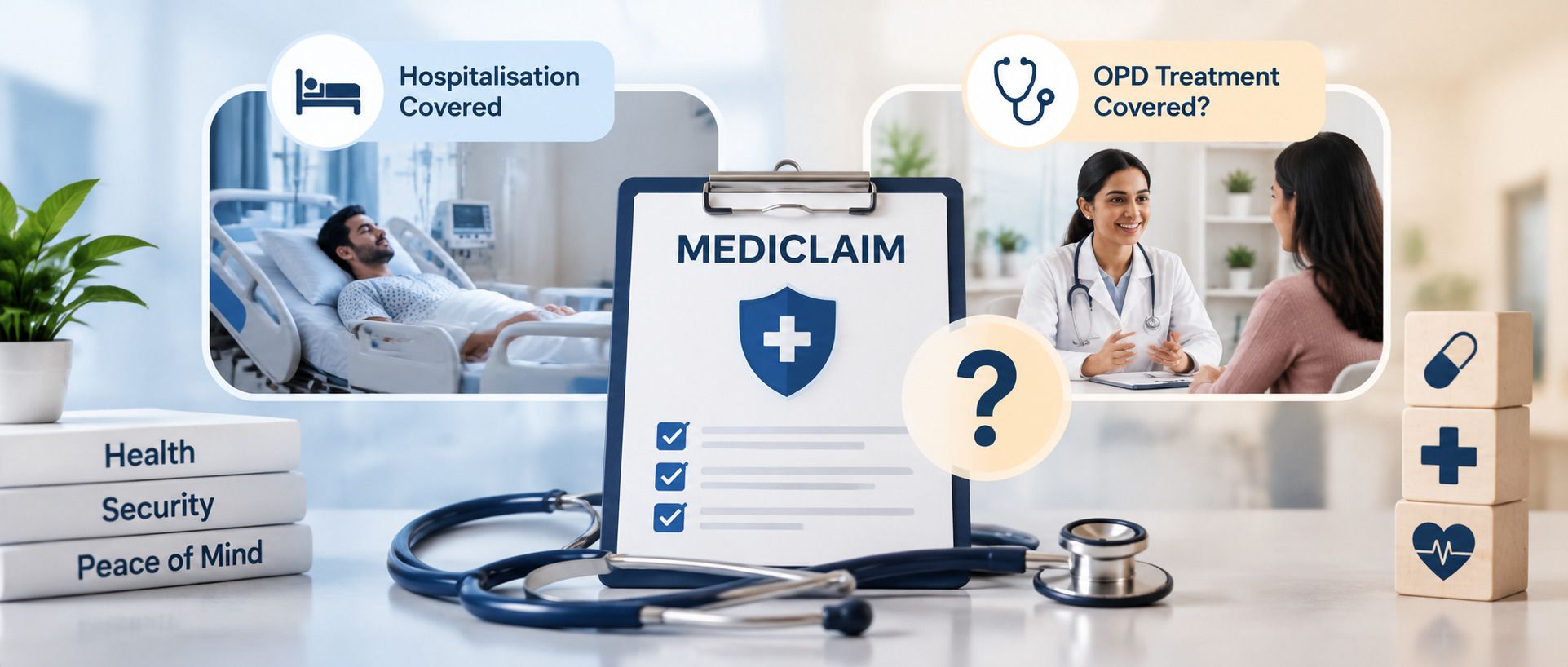
Unfortunately, this confuses most people, and it is genuinely important to get it right before you buy a policy. Standard health insurance plans in India are built IPD-first. Now, in the bigger picture, that’s not a flaw. Hospitalisation is expensive and unpredictable, so it makes sense to insure against it first. But it creates a blind spot: the everyday healthcare costs you have to carry on your own, quietly, month after month.
OPD cover is largely optional and is usually offered as an add-on rider or within specific comprehensive plans. And the Insurance Regulatory and Development Authority of India (IRDAI) requires insurers to clearly disclose what is and what isn’t included in your policy document.
4. Government Schemes
Even India’s flagship public health scheme illustrates this divide clearly. Govt.’s Ayushman Bharat – Pradhan Mantri Jan Arogya Yojana (AB-PMJAY) provides coverage of up to ₹5 lakh per family per year. But this is strictly for secondary and tertiary hospitalisation, i.e., IPD care. Routine OPD consultations are explicitly excluded from the scheme.
The Financial Reality Behind OPD in India
According to the National Health Accounts (NHA) estimates released by the Union Ministry of Health and Family Welfare, out-of-pocket expenditure (OOPE) as a share of India’s total health expenditure has fallen from 64.2% in 2013-14 to 43.4% in 2022-23. Overall, this seems like real progress driven by wider hospitalisation coverage.
However, a large share of what households still pay out of their own pockets goes toward outpatient care, medicines, and diagnostics. People are quietly paying for every fever, every allergy test, every dental filling, and every physiotherapy session out of their own salary. Those very expenses fall under OPD and are least likely to be covered by a basic health policy.
In other words, your IPD risk might be well protected, but your everyday OPD spending could quietly be draining your wallet all year round. It’s good that more Indian families are now looking for health covers that bundle both OPD and IPD benefits, rather than assuming hospitalisation cover alone is “complete” protection.
When Should You Choose OPD vs IPD Treatment?
You don’t really “choose”; your doctor decides based on your condition. But here’s a simple way to know what to expect:
Go the OPD route when you have
- Fever, cold, cough, or seasonal infection
- Minor injuries like small cuts or sprains
- Routine health check-ups or vaccination
- Follow-up consultations after a past treatment
You will likely need IPD when there is
- Scheduled or emergency surgery
- Serious illness needing round-the-clock monitoring
- Childbirth or delivery
- Medical condition requiring IV medication, oxygen support, or ICU care
Why This Distinction Matters for Your Health Insurance
Many first-time policyholders assume their health insurance covers “everything medical.” In reality, most base plans are designed for IPD, and OPD benefits usually come as a separate rider, a top-up, or as part of more comprehensive plans.
Whenever you buy or renew a policy, always check:
- Does the policy cover daycare procedures (short IPD-like admissions under 24 hours)?
- Is OPD cover included, or is it a separate add-on?
- What is the annual OPD limit, and does it cover consultations, diagnostics, and pharmacy bills?
- What is the claim process: cashless or reimbursement?
At Prime.care, we believe your health cover should reflect how you mostly use healthcare; the everyday doctor visits, tests, and prescriptions too.
So, we designed our health plans around primary care, i.e., routine OPD needs. Scroll through our health insurance plans and let the benefits work together for your family.
Common Myths About OPD and IPD
My health insurance covers all my medical expenses: Not necessarily. Unless you have specifically opted for OPD cover, your policy likely includes IPD hospitalisation only.
Daycare procedures are the same as OPD: No. Daycare procedures like cataract surgery, chemotherapy, or dialysis involve hospital admission for a few hours. They are typically treated under IPD/hospitalisation cover, not OPD.
OPD cover isn’t worth buying: For families with children, elderly parents, or chronic conditions requiring regular doctor visits, OPD cover can significantly reduce recurring healthcare costs over a year.
Frequently Asked Questions
What is the difference between IPD and OPD in a group health insurance policy?
IPD (Inpatient Department) covers treatment that requires hospital admission, such as surgery or serious illness, and is usually included by default in group health policies. OPD (Outpatient Department) covers consultations, diagnostics, and minor treatments that don’t need admission, and is typically offered as an optional add-on.
Can an OPD consultation turn into an IPD admission?
Yes. If an OPD doctor diagnoses that your condition requires continuous IV medication, surgery, or monitoring, they will recommend IPD admission.
Is 24-hour hospitalization mandatory for all IPD insurance claims?
Standard IPD claims require 24 hours, but recognized ‘Daycare Procedures’ (cataract, dialysis, chemotherapy) are covered even under 24 hours.
Is OPD covered under health insurance in India?
Not always by default. Most standard health insurance plans primarily cover IPD (hospitalisation) expenses. In contrast, OPD cover is usually available as an optional add-on or rider, subject to the specific plan’s terms.
Does Ayushman Bharat (PMJAY) cover OPD expenses?
No, the Ayushman Bharat–PMJAY scheme provides up to ₹5 lakh per family per year specifically for secondary and tertiary hospitalisation (IPD care) and does not cover routine OPD consultations.