Three months with irregular periods. Breakouts along the jawline that no face wash can fix. More hair in the brush than on your head, and a few too many on your chin. “Is something off with my periods?”, the question you have been dodging for months finally surfaces. One search later, you are knee-deep in advice suggesting how to deal with PCOS. But not the one that really keeps you awake: what will all this care cost?
Fair thing, because PCOS is rarely one big bill. It is a gynaecologist visit here, a scan there, a round of blood tests, a monthly strip of tablets and follow-ups that carry on for years. None of it needs a hospital bed.
In this guide, we explain PCOS symptoms and treatment, share practical PCOS self care and hair care tips, and show you how to plan the outpatient costs in one place with Prime Care.
What Is PCOS, and How Common Is It in India?
PCOS is a hormonal condition in which the ovaries may not release eggs regularly, and the body makes more androgens (the so-called "male" hormones that every woman has in small amounts) than usual. As per the World Health Organization, PCOS affects roughly 8 to 13 per cent of women of reproductive age, and up to 70 per cent of them are never diagnosed. Which means, for every ten women living with PCOS, as many as seven may not know it. In India, studies reported in the Indian Journal of Medical Research put a wide range of 3.7 to 22.5 per cent, depending on who was studied and which diagnostic criteria were used. One urban community study in Mumbai found 22.5 per cent using the Rotterdam criteria, while a Tamil Nadu study of adolescents reported 18 per cent.
In the same review, PCOS-related hormone imbalance has also been linked with insulin resistance, glucose intolerance and heart risk. What does that mean for you? If your cycles are unpredictable or your skin and hair have changed, a check-up is worth the time. PCOS care is not only about periods. It is about your long-term health. You are far from alone, and you are probably not "just stressed".
PCOS Symptoms and Treatment: What to Look For and What Helps
Common PCOS symptoms
Symptoms differ from woman to woman and can change over time. These are the most common ones:
- Irregular, infrequent or missed periods
- Acne and oily skin that keep coming back
- Extra hair on the face, chest or abdomen (hirsutism)
- Thinning hair on the scalp
- Weight gain around the waist
- Dark, velvety patches on the neck, underarms, or groin (acanthosis nigricans), a sign of insulin resistance
- Difficulty in conceiving
- Low mood, anxiety or poor sleep
How PCOS is diagnosed
Doctors usually diagnose PCOS when at least two of three features are present, after other causes are ruled out: irregular or absent ovulation, signs of high androgens (on the body or in a blood test), and polycystic ovaries on ultrasound. So, a typical work-up combines an examination, hormone tests and a pelvic scan.
According to the 2023 International Evidence-based Guideline, endorsed by 39 organisations worldwide, in adults an anti-Müllerian hormone (AMH) blood test can sometimes stand in for an ultrasound in adults. Also worth knowing: you can have PCOS without ovarian cysts, and cysts alone do not mean you have PCOS.
PCOS treatment options
While there is no cure, the symptoms can be managed well. Your treatment plan will depend on what bothers you most and whether you are planning a pregnancy. It usually includes:
- Lifestyle care: the guideline puts a healthy lifestyle at the centre of care for every woman with PCOS.
- Medicines: for example, hormonal pills to regulate cycles and settle acne or unwanted hair, anti-androgen tablets, or metformin when insulin resistance is a concern. These are prescription medicines, so please do not self-start them.
- Fertility support: if and when you are trying to conceive.
- Regular follow-ups: to monitor blood sugar, cholesterol, blood pressure, and mood.
How to Deal With PCOS: Practical Plan
A PCOS diagnosis can feel heavy, especially when the advice online is contradictory. Start small:
- Get a proper diagnosis. Do not rely on a single symptom or a scan report alone.
- Choose one doctor to lead your plan. Keep all your reports in one folder or phone album.
- Track the basics. Note your period dates, skin, hair fall and weight once a month. Patterns help your doctor adjust treatment.
- Look after your mind too. If low mood or anxiety lingers, say so at your next visit. It is part of PCOS care, not a side issue.
PCOS Self Care: Small Habits That Add Up
Forget the "perfect PCOS lifestyle" you see on social media. Good PCOS self care is about habits you can repeat, even on a tiring Wednesday. Choose what suits your kitchen and your schedule.
- Eat for steady blood sugar. Pair carbohydrates with protein and fibre. Build plates around dal, sabzi, curd, eggs or paneer, and whole grains such as jowar, bajra and ragi. Go easy on sugary drinks, maida and deep-fried snacks.
- Move often. FOGSI's practice points mention 150 to 300 minutes of activity per week as beneficial, which works out to about 30 to 40 minutes on most days. Brisk walks, cycling, dance, yoga or strength training all count.
- Guard your sleep. Aim for a regular bedtime and seven to eight hours. Poor sleep makes cravings and stress harder to handle.
- Give stress an outlet. Take a walk after dinner, ten minutes of breathing practice, or a chat with a counsellor can all help.
- Skip crash diets. If your doctor suggests weight loss, slow and steady works better, and extreme dieting can worsen hair fall.
How to Take Care of Hair in PCOS
Hair is often what bothers women most, and PCOS can do two opposite things at once: thin the hair on your head and thicken it elsewhere, like your face or body. Both come from raised androgens, and the WHO lists unwanted facial or body hair and scalp hair loss among the signs doctors look for. Here’s what helps:
- See a doctor before buying serums to identify the cause. Initially a dermatologist or gynaecologist can check for other causes of shedding, such as low iron, low vitamin D, or thyroid problems, and may suggest treatments like minoxidil or anti-androgen tablets. Some of these medicines are unsafe in pregnancy, so discuss contraception too.
- Keep the routine gentle. Use a mild shampoo as your scalp needs, condition the lengths, comb wet hair with a wide-tooth comb, and go easy on heat styling and tight ponytails.
- Feed your hair. Include protein and iron-rich foods such as dal, rajma, eggs and leafy greens in your daily meals.
- Be patient. Hair grows in cycles, so changes usually take three to six months to show. Click a photo every month to track progress.
What Does a Year of PCOS Care Actually Involve, and How Does Prime Care Help?
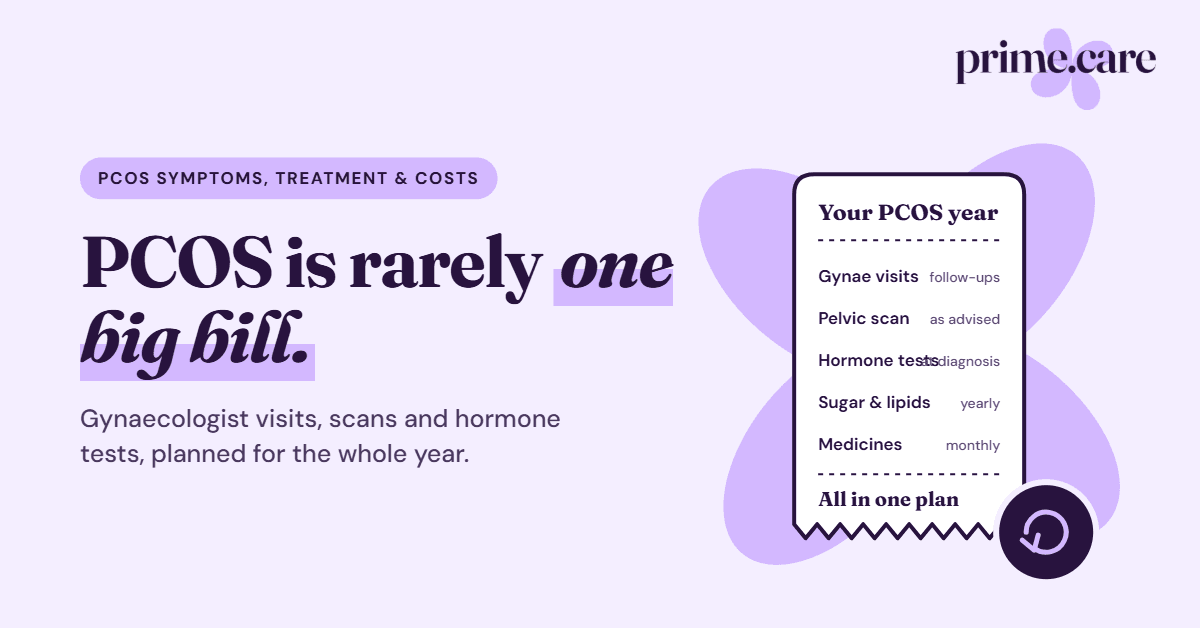
Your doctor will decide what you need, but this is a typical outline of outpatient PCOS care:
| Care step | Why it is done | How often |
| Gynaecologist or endocrinologist visit | Diagnosis, treatment plan and prescriptions | At diagnosis, then follow-ups as advised |
| Pelvic ultrasound | To look at the ovaries and the uterine lining | When your doctor advises |
| Hormone tests (such as testosterone, LH, FSH, prolactin, TSH; sometimes AMH) | To confirm PCOS and rule out look-alikes like thyroid problems | At diagnosis; repeated if needed |
| Sugar and cholesterol tests | To check metabolic risk | Usually once a year or as advised |
| Dermatologist visit | For hair fall, acne or unwanted hair | As needed |
| Medicines | Cycle control, skin, hair, insulin resistance | Monthly refills |
Look at that table again, and you will notice that almost every line is an outpatient expense. Most standard health insurance policies don’t pay for them because they don’t need hospital stay. This is the OPD gap. If you want the basics, read what OPD cover means and whether mediclaim covers OPD treatment in India.
Here is where Prime Care comes in. It is an OPD plan, built for the healthcare you use throughout the year, not just during a hospital stay. You can activate with quick KYC and no medical tests, with no waiting period and a 15-day refund promise. You can use your wallet cashlessly at network clinics, labs, and pharmacies by scanning your card.
Every plan also includes unlimited 24/7 GP tele-consultations, an annual health check-up at home, and vision and dental cover. See the full table on our coverage page.
How does that map to the plan above? Your consultations, hormone and sugar tests, and monthly medicines are exactly the kind of prescribed outpatient care the wallet is designed for. If you expect more tests and more follow-ups, a higher wallet limit gives you more room.
See which wallet fits your year of visits, scans and tests, and start using it from day one. Find your Prime Care plan.
Frequently Asked Questions
What are the first signs of PCOS?
Irregular or missed periods are the most common first sign. Many women also notice persistent acne, extra facial or body hair, thinning scalp hair or unexplained weight gain. Since symptoms vary, see a gynaecologist if two or more of these keep recurring.
Can PCOS be cured completely?
No. According to the WHO, PCOS cannot be cured. Still, symptoms can be improved through lifestyle changes, medicines and fertility treatment when needed. With consistent care, most women lead healthy lives and many conceive.
How can I take care of my hair if I have PCOS?
Start with a medical check for causes like low iron, vitamin D or thyroid problems. Then follow a gentle routine, eat enough protein and iron, avoid crash diets and use treatments for three to six months. Prescription options such as minoxidil or anti-androgens should only be used on a doctor's advice.
Which tests are done to diagnose PCOS?
Doctors usually combine a physical exam, a pelvic ultrasound and blood tests. Hormone tests may include testosterone, LH, FSH, prolactin and thyroid (TSH), with AMH in selected adults. Blood sugar and cholesterol tests check for related metabolic risks.
Does regular health insurance cover PCOS consultations and tests?
Standard policies are mainly designed for hospitalisation, so routine consultations, scans, and lab tests are often left out unless the policy has an OPD add-on. Our guide to mediclaim and OPD explains the difference.