
Skin and Hair Problems: When to See a Dermatologist and What a Visit Costs

4 NOV '268 min
You are in the shower, and the drain tells you something the mirror hasn't yet. Or it is 2 a.m. and you are scratching the same rash on skin you were scratching last week while blaming the new detergent. You promise yourself you will "see how it goes." Skin and hair problems are rarely emergencies, so they slip to the bottom of the to-do list. Most of us do the same thing next: try a home remedy, order a miracle serum online, ask a cousin, and wait. Sometimes waiting works. Often, it only delays the one thing that helps, which is a proper diagnosis.
So let us clear it up. We will explain to you when skin and hair problems deserve a specialist, what a dermatologist for hair fall actually does, how patch testing works, and how to plan the money side so that cost never becomes the reason you postpone care.
Signs Your Skin Or Hair Needs A Specialist, Not Another Home Remedy
Most itches and shedding spells do settle by themselves. But the trouble is that you cannot tell which ones will. That is why dermatologists, who are doctors trained in skin, hair and nails, are worth meeting early rather than late. Book a visit sooner rather than later if you notice any of the following.
For skin
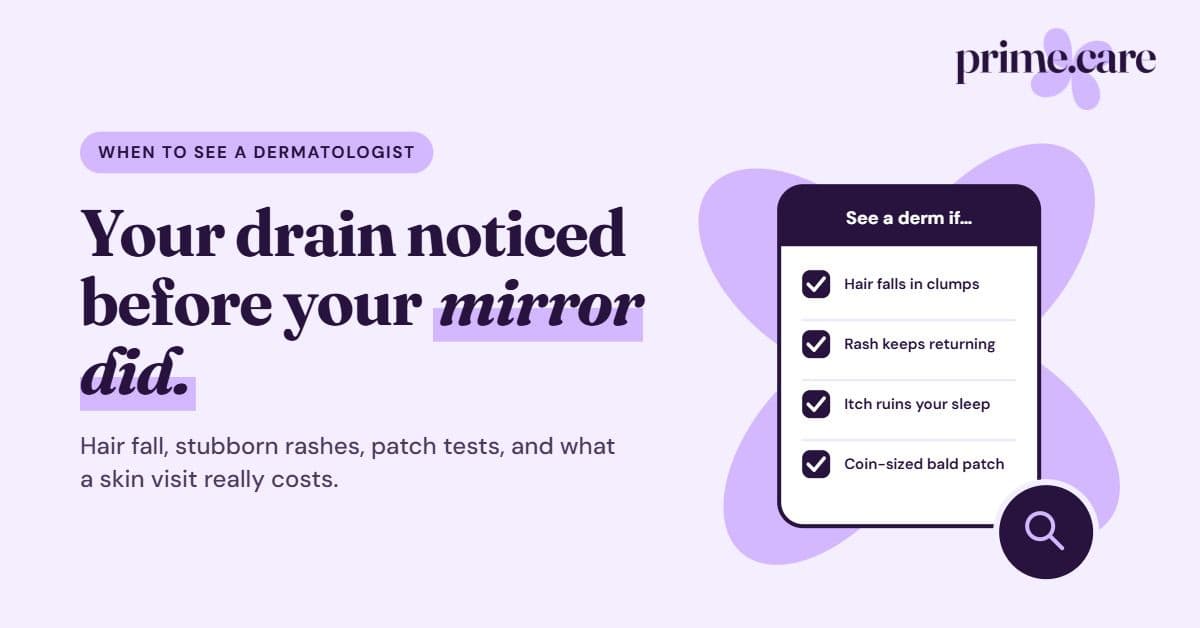
- Rashes that keeps coming back or do not settle with ordinary care
- Itching that disturbs your sleep
- Repeated reactions to cosmetics, hair colour, jewellery or chemicals at work
- Mole or spot that changes in size, shape or colour
For hair
- Heavy shedding in clumps , a widening parting or a receding hairline
- Round, coin-sized bald patches
- Hair fall lasting more than six months, which Indian dermatologists treat as chronic
When both show up together
Sometimes hair and skin raise the alarm together. A dermatologist looks after both, so these are worth one visit rather than two:
- Itching, burning, redness or flakes on the scalp
- Hair fall along with irregular or heavy periods, acne or unusual facial hair
Go to emergency care instead if a skin reaction brings swelling, vomiting or difficulty in breathing.
Dermatologist For Hair Fall: What Really Happens In The Clinic
Hair fall is a symptom, not a diagnosis. Something happened inside your body, and your hair is reporting it late. As per a consensus paper by 120 dermatologists in 11 Indian cities, published in the International Journal of Trichology, telogen effluvium (diffuse shedding) shows up two to three months after a trigger such as high fever, major surgery, crash dieting, thyroid trouble, nutrient deficiency such as low iron or vitamin levels, certain medicines, or heavy emotional stress. In roughly one-third of cases, no trigger can be found.
So what does a dermatologist do for hair fall that a shampoo ad can't?
- Detailed questions. How long it has been going on, what changed three months ago, recent illness, diet, periods, medicines and the hair products you use.
- Close scalp examination. The doctor studies the pattern of loss and does a gentle hair-pull test. Trichoscopy, a magnified look at the scalp, often helps avoid a biopsy.
- Basic blood tests. For diffuse hair loss, the panel suggests a complete blood count, urine examination, vitamin D and thyroid function. Iron studies, vitamin B12, zinc or hormone tests are added only when your history points that way.
And the part that surprises people is, many patients don’t know that losing up to 100 hairs a day is normal. They also say high-dose biotin has no proven benefit unless you are actually deficient, that hair oil doesn't play a big role in treatment, and that PRP isn't meant for acute shedding. Telogen Effluvium is usually self-limiting, once the trigger is fixed, regrowth can begin in months, though full recovery may take over a year. Patience, in other words, is part of the treatment.
Which Hair Loss Treatment Doctor Should You See First?
Start with a dermatologist. They can tell pattern baldness from temporary shedding, scalp infections and patchy autoimmune loss, and each needs different treatment. Your general physician can start the basic blood tests while you wait for a slot.
The Itch That Keeps Coming Back: Patch Testing In Plain Words
When a rash keeps returning and you cannot work out why, your dermatologist may suggest patch testing. According to the American Academy of Dermatology, over 15,000 substances can cause an allergic skin reaction, so guessing is a long game and a patch test looks for delayed allergies, the kind that appear over hours or days. With a skin prick test, immediate reactions can be checked.
Here's how the week goes:
- Day 1: Small amounts of allergens are placed on patches, usually on your back
- Day 3: You return; patches come off and the first reading is done
- 4 to 7 days after the patches go on: Final review, because some reactions are slow to show
Keep the patches dry and don't scratch them. Wetting or scratching the patches can spoil the result. Expanded patch testing, designed for job-related exposures, picks up about 80 per cent of allergens. If you have psoriasis, mention it, because patches can trigger a flare. Once the culprit is known, your doctor builds a plan around avoiding it, and for many people the rash clears.
Allergy Test Cost And Patch Testing Cost: What Sets The Bill
So what will it cost? You won’t find a single official national price for patch testing or an allergy test, since quotes differ from clinic to clinic. The bill depends on:
- How many allergens are in the panel, and whether it is a standard series or an extended one
- How many visits are included: application, removal and final reading
- Whether blood tests are advised alongside
- The consultation fee, your city and the type of facility
Ask for a written estimate that states the number of allergens and visits covered. And do not choose a test from a price list; let your dermatologist decide which one answers your question.
Dermatologist Consultation Fees: What To Budget
Fees depend on the city, the doctor's experience and whether it is a first visit or a follow-up. As a reference point, the doctor listings on Fortis Healthcare show published fees of about ₹800 for a dermatology consultant at a Bengaluru centre and ₹1,200 to ₹1,800 at Mumbai centres (checked October 2026). Smaller clinics and online consultations may charge differently.
One hair or skin problem rarely ends with one visit. Since hair treatment can take three to four months to show results, budget for review visits too:
| Step | What happens | Ask about the cost of |
|---|---|---|
| First visit | History, scalp or skin examination | Consultation fee |
| Investigations | Blood tests, patch test or other advised tests | Each test, in writing |
| Treatment | Prescribed creams, lotions or tablets | Monthly medicine spend |
| Follow-up | Review after a few weeks or months | Repeat-visit fees |
Unfortunately, this is the bit health insurance usually misses. Most policies pay when you are hospitalised, not for clinic visits, blood tests and pharmacy bills, which are exactly what skin and hair care involve.
How Prime.Care Helps You Pay Less For Everyday Skin And Hair Care
We built Prime.care for exactly this gap. It is an OPD plan, so instead of waiting for a hospital stay, you get a yearly wallet for everyday care, spent cashlessly by scanning a QR at network clinics, labs and pharmacies.
Family plans cover up to four members on one shared wallet. Every plan includes in-clinic doctor consultations, prescribed diagnostics and pharmacy, with no waiting period and a 15-day refund promise. Our network includes Apollo 24|7, Tata 1mg, Redcliffe Labs, Agilus Diagnostics, Fortis, and Fit-Pass.
Wallet limits are split by benefit type, each QR transaction is capped at ₹2,000, and hospitalisation and cosmetic procedures are not covered. Consultations, prescribed blood tests and medicines for a hair-fall workup are the kind of spend the wallet is made for.
Before you book, check the coverage details to see what applies at your nearest partner. You can also read why OPD cover works alongside health insurance, or how health insurance treats medicine costs.
Don't let a small problem become a six-month one! Get yourself covered in 2 mins, see a specialist, and let a wallet handle the repeat visits
Frequently Asked Questions
Should I see a dermatologist or a general physician for hair fall?
Start with a dermatologist, who can diagnose the type of hair loss. A general physician can begin basic blood tests in the meantime.
What are dermatologist consultation fees in India?
They vary by city and doctor. Published fees at some large hospital centres range from about ₹800 to ₹1,800 per visit, so confirm the first-visit and follow-up fees when you book.
How long does patch testing take?
About a week, over two or three visits: application, a reading after 48 hours and a final review four to seven days after the patches go on.
How much does an allergy test and patch testing cost?
There is no fixed national rate. It depends on the allergens tested, visits included and facility, so ask for a written estimate first.
Will Prime.care cover my dermatologist visit?
Our plans cover cashless in-clinic doctor consultations, prescribed diagnostics and pharmacy at network partners, within wallet limits. Cosmetic procedures and hospitalisation are excluded, so check the coverage page for your nearest partner.




 Message us on WhatsApp