
GP or Specialist? Choosing the Right Doctor for Everyday Health Problems

4 NOV '269 min
It starts with a scratchy throat on a Monday, or a niggling knee on a Thursday. You reach for your phone and then pause: should I see my regular doctor, or go straight to a specialist? Most of us in India simply guess. We walk into whichever clinic is nearest or whoever someone mentioned at a family function as the best. It works well, right up to the day it does not.
Maybe you paid a specialist's fee for something your regular doctor would have sorted in ten minutes. Maybe you sat on a nagging symptom for weeks because "it is probably nothing", and it turned out to be something. Neither choice is wrong, but both can cost you time and money you did not need to spend.
So let us fix that and give you a simple way to decide. We will walk you through the family physician, the internal medicine doctor and the specialist, explain what OPD consultation means, show you how to compare a general physician near me with fees, and tell you when an online physician consultation is good enough.
What Does a Family Physician (GP) Actually Do?
Think of a family physician, or GP (General Physician), as the person who holds the whole map. They are your first and most frequent point of contact, and the one who sees the whole picture: your history, your family's history, your habits and your medicines. They know that your father has diabetes, that your acidity flares up around exam season, and that your BP was a little higher last winter. That background is gold when a new symptom shows up.
For everyday problems, a GP can usually diagnose and treat you on the spot. Typical examples include fever, cough and cold, loose motions, acidity, headaches, minor skin infections, urinary complaints, seasonal allergies, and follow-ups for blood pressure or sugar that is already under control. Additionally, they can also give vaccinations, order basic tests and, importantly, know when you need someone else and refer you accordingly.
And the best part is continuity. When the same doctor sees you over the years, small changes get noticed early. Nobody sees a few extra kilos or a slowly climbing BP reading as an emergency, but a doctor who knows you will notice the pattern.
Internal Medicine Doctor: Problem-Solver For Complex Cases
An internal medicine doctor, often called a consultant physician, is trained to diagnose and manage complex illnesses in adults, especially when more than one thing is going on. In India, the terms ‘GP’ and ‘internal medicine doctor’ are used loosely for the same person. The difference is mostly depth. Consider an internal medicine doctor when:
- You have more than one long-term condition, say diabetes with high BP and thyroid trouble, and your medicines need careful balancing.
- Recurring fever that does not settle even after several days, or you notice unexplained weight loss, constant fatigue or recurring infections.
- Your GP has done the first round of tests and the picture is still unclear.
Here is a simple picture: the family physician is your first responder, and the internal medicine doctor is the detective who steps in when the case gets complicated.
When Should You Skip GP And See Specialist Directly?
Sometimes going straight to a specialist saves you a detour. It makes sense when:
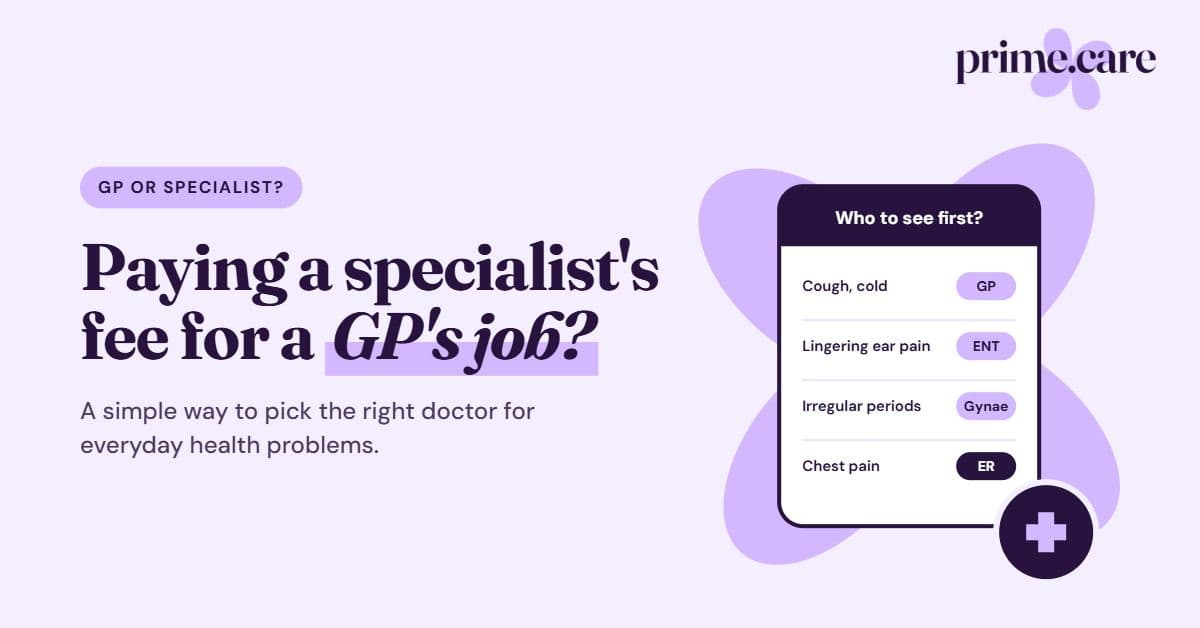
- Problems clearly belong to one organ or system, such as persistent ear pain, a suspected fracture, sudden changes in vision or irregular periods.
- You already have a diagnosis and need focused, ongoing care, like a cardiologist for a known heart condition.
- You need a routine screening that only a specialist performs, such as a Pap smear or a detailed eye check.
- Your doctor has already referred you.
If you are unsure, start with the GP: a ten-minute conversation either saves you an unnecessary specialist fee or confirms that you were right to go directly.
Women's health is one area where going direct is common and sensible. If that applies to you, our guides on health check-ups for women and PCOS care costs will help you plan. And if you are in your 30s and have been diagnosed with High BP, set a follow-up plan for yourself as well.
Quick Cheat-Sheet: Who To See First?
| Your problem | Start with | Why |
|---|---|---|
| Fever, cough or cold for 1 to 3 days | Family physician | Common and easy to assess |
| Fever for more than 3 days, or with rash, bleeding or severe body ache | Family physician, promptly | Needs tests, especially in dengue and malaria season |
| BP or sugar newly high | Family physician, then internal medicine | Baseline tests first, then a long-term plan |
| Several chronic conditions | Internal medicine doctor | Medicines need coordination |
| Irregular periods or pelvic pain | Gynaecologist | Needs a specialist examination |
| Ear, nose or throat trouble that lingers | ENT specialist | Needs special instruments |
| Chest pain, severe breathlessness, fainting | Emergency care at once | Do not wait for an appointment |
Searching “General Physician Near Me With Fees”? Ask These Five Things
It’s a smart move to check the fee first, it shows you are already thinking about cost. Just do not stop there. Before you book, ask:
- What does the fee cover? Some clinics include a free review within a few days. Others charge again.
- What else will I pay for? Tests, scans and medicines are usually extra, and they can easily outrun the consultation fee.
- Can I get an appointment this week? A great doctor you cannot reach is not much use when you are unwell.
- Is the doctor registered? Look for registration with a State Medical Council or the National Medical Commission.
- Is teleconsultation offered? It can save you a trip for follow-ups.
We have deliberately not quoted a single "average" fee, because it would mislead more than help. Fees differ so much: a neighbourhood clinic, a multi-speciality hospital OPD and a metro consultant can charge very differently.
Compare two or three nearby options on fee, follow-up policy and distance, then choose the doctor you can comfortably see regularly.
Online Physician Consultation: Your 11 Pm Sounding Board
Imagine: it is late, the clinic is shut, and you are wondering whether that rash or that fever needs attention tonight or can wait until morning. Online consultations are made for exactly these moments.
An online physician consultation, whether by video, audio or chat, is now a normal part of Indian healthcare. It is guided by the Telemedicine Practice Guidelines, 2020, which allow only a registered medical practitioner to offer teleconsultation and expect the doctor to keep a digital record and use clinical judgement on whether a remote consult suits the problem.
It works nicely for mild, familiar complaints, medicine reviews, follow-ups on stable conditions, and for making sense of a test report you do not fully understand. It will also tell you whether you need to be seen in person.
What it cannot do is examine you. Let’s say you have a lump, a swelling, severe abdominal pain or anything that needs tests before a diagnosis, all these call for an in-person visit. And a real emergency never belongs on a video call.
When You Should Not Wait For Any Appointment
Some situations need emergency care straight away, not an appointment. These include chest pain or pressure, severe breathlessness, sudden weakness on one side of the body, slurred speech, fainting, heavy bleeding, high fever with confusion or a stiff neck, and thoughts of harming yourself. Go to the nearest hospital emergency department or call 112, India's emergency number.
What Exactly OPD Consultation Means
OPD (Outpatient Department) consultation means a visit to a doctor where you are examined and sent home the same day, without being admitted to hospital. Your GP appointment, the dermatologist visit, the post-surgery follow-up and the video call with a physician are all OPD.
Why does a term like this matter to your wallet? Because OPD is where most of us pay, month after month, from our own pocket. As per the latest National Health Accounts for 2022-23, out-of-pocket payments made up 43.4 per cent of India's total health expenditure. Ordinary visits are not small changes. They are where the money goes. Even the Parliamentary Standing Committee on Health has pointed out that nearly 70 per cent of health spending in India goes to outpatient care, which PM-JAY does not cover.
In simple terms, it is often not one big hospital bill that drains a family, but the steady stream of consultations, tests and medicines in between. Choosing the right doctor the first time is therefore a money decision as much as a medical one.
How Prime.Care Makes Your Decision Easier
Knowing which doctor to see is half the battle. Paying for it without stress is the other half. That is where Prime.Care comes in. It is built around everyday outpatient care, the kind that regular hospitalisation cover usually leaves out. With any of our plans, routine consultations stop becoming something you worry about.
- You can see a family physician early, instead of waiting for a symptom to become a problem.
- You can go to a specialist when your doctor recommends one, without agonising over the cost.
- You can actually attend follow-ups, which is where many conditions are caught and controlled.
Exact benefits, limits and network details are listed on our coverage page, so do read the plan terms before you use them.
Frequently Asked Questions
Should I see a GP or a specialist first?
For most new, mild or unclear symptoms, start with a GP or family physician. They can treat common problems and refer you if needed. Go directly to a specialist when the problem clearly belongs to one organ or you already have a diagnosis.
Is a family physician the same as an internal medicine doctor?
Not exactly. A family physician looks after common health problems for people of all ages. An internal medicine doctor focuses on adults, especially those with complex or multiple conditions. In India, the two roles often overlap.
What does OPD consultation mean?
OPD, or outpatient department, consultation means seeing a doctor without being admitted to hospital. You are examined, get advice or a prescription, and go home the same day.
Is an online physician consultation as good as visiting in person?
For suitable problems, such as mild illnesses, follow-ups and report reviews, yes. It cannot replace a physical examination, so your doctor may ask you to visit in person if needed. Never use it for emergencies.
How do I find a general physician near me with fees that suit my budget?
Search locally and compare two or three doctors on consultation fee, follow-up policy, timings and distance. Ask what the fee includes, confirm the doctor's registration, and consider a plan that covers routine OPD visits.



 Message us on WhatsApp